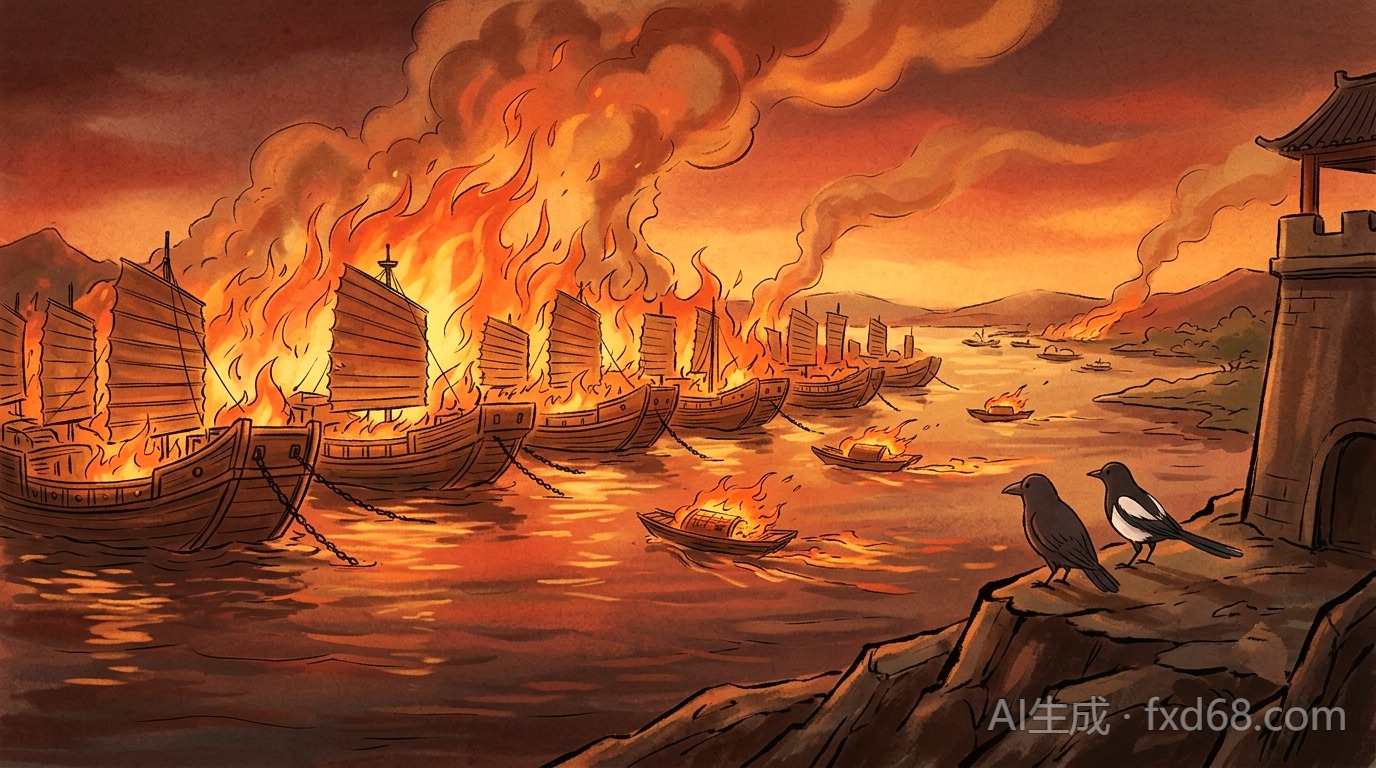
公元208年,东汉末年,曹操统一北方后挥师南下,意图一举吞并江东的孙权与依附而来的刘备。孙刘联军兵力远远少于曹操大军,双方在长江赤壁一带(今湖北赤壁市西北)对峙。这场战役被陈寿写进了《三国志》,是真实发生过的历史事件,并非全是小说家言。
In 208 CE, near the end of the Han Dynasty, Cao Cao unified the north and led his army south, intending to conquer Sun Quan of the southeast and Liu Bei, who had allied with him. The Sun-Liu allied forces were far outnumbered by Cao Cao's army, and the two sides faced off along the Yangtze River near Red Cliffs, in present-day northwest Chibi, Hubei. This battle was recorded by Chen Shou in the official history Records of the Three Kingdoms, so it is a real historical event, not purely a novelist's invention.
东吴将领黄盖献上火攻之计,先诈称投降接近曹军战船。曹操因北方士兵不习水战,将战船首尾用铁索连接以减少摇晃,谁知这反倒成了火攻的天然弱点。趁着东南风起,黄盖的船队点火冲向曹军连船,大火迅速蔓延,曹操大军溃败北撤,此战直接促成了后来魏蜀吴三国鼎立的格局。
Huang Gai, a general of the Eastern Wu, proposed a fire attack strategy, first faking surrender to get close to Cao Cao's warships. Because his northern soldiers were unfamiliar with naval warfare, Cao Cao had chained his ships together bow to stern to reduce rocking, but this ended up becoming the fatal weakness the fire attack exploited. When the southeast wind rose, Huang Gai's fleet set fire and charged into Cao Cao's chained ships, the flames spread rapidly, and Cao Cao's army collapsed and retreated north. This battle directly led to the later Three Kingdoms standoff between Wei, Shu, and Wu.
🔥 号称百万雄师,却在长江上被一把火烧得溃不成军——
当阿鸦讲起这场三国最经典的以少胜多之战,小喜才明白,真正的智慧,往往比兵力更致命。
付费解锁完整故事 · 火烧赤壁 · 趣味词卡
- 🔥 赤壁之战本期 · NOW
- 🦕 恐龙与鸟类进化点击进入
- 🕳️ 黑洞与宇宙大爆炸点击进入
- 🏃 夸父追日点击进入
- ⚡ 雷神的两个传说点击进入
- 🦋 梁山伯与祝英台点击进入
- ⚡ 诸神黄昏点击进入
- 🐺 阿努比斯与死亡点击进入
- 🌊 波塞冬与海洋点击进入
- 🐍 美杜莎与珀尔修斯点击进入