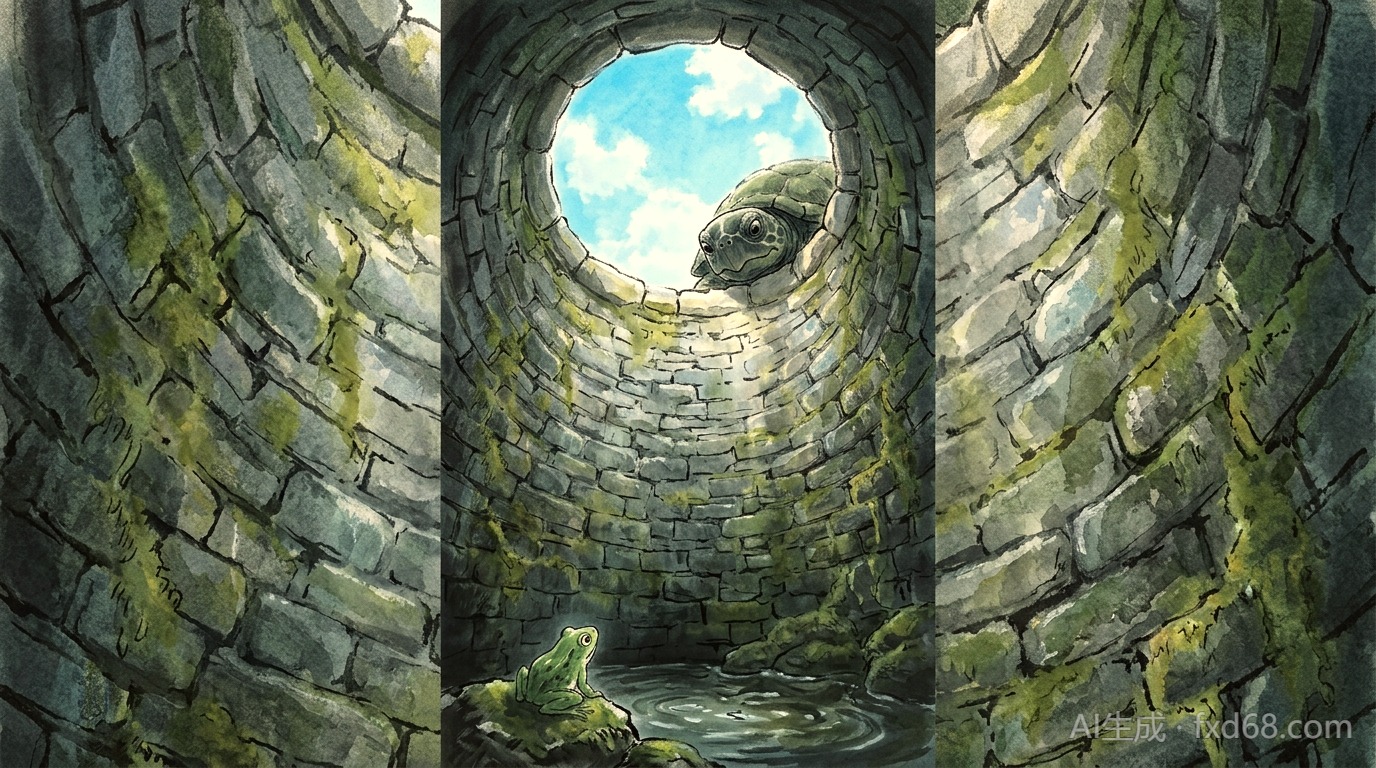
"井底之蛙"出自战国时期思想家庄子(约公元前369年—前286年)的《庄子·秋水》。原文里,住在井里的是一只"埳井之蛙",也就是浅井里的青蛙;来做客的是"东海之鳖",鳖是一种和海龟很像的动物,我们的故事里把它讲成了海龟。原文写海龟"左足未入,而右膝已絷矣",左脚还没伸进去,右膝盖就被卡住了,两千多年前的文字,读起来也很有画面感。
The Frog in the Well comes from the chapter Autumn Floods in the Zhuangzi, by the Warring States thinker Zhuangzi (about 369 to 286 BC). In the original, the frog lives in a shallow, broken well, and the visitor is a turtle-like creature from the Eastern Sea, which our story tells as a sea turtle. The original says that before the turtle's left foot was even inside, its right knee was already stuck. More than two thousand years old, the words still paint a vivid picture.
《秋水》这一篇里,还有一句和青蛙有关的名言:"井蛙不可以语于海者,拘于虚也。"意思是,没法跟井里的青蛙谈论大海,因为它被自己住的地方限制住了。庄子用这个比喻提醒人们:每个人的见识都有局限,要承认自己看到的只是世界的一小部分。今天,人们还会用"井蛙之见"来形容狭隘的看法。
The same chapter contains a famous line about frogs: you cannot talk about the sea with a frog in a well, because it is limited by the place where it lives. Zhuangzi used this image to remind people that everyone's knowledge has limits, and that we should admit we see only a small part of the world. Today, people still use the phrase the view of a frog in a well to describe a narrow point of view.
🐸 第一百七十七个故事,一口旧井里的小青蛙,一只从东海来的大海龟,还有一片井口装不下的天空
付费解锁完整故事 · 完整情景对话 · 趣味词卡
- 🐸 井底之蛙本期 · NOW
- 🐠 渔夫和金鱼点击进入
- 🍪 姜饼人点击进入
- 🪔 阿拉丁神灯点击进入
- 🫏 不来梅的城市乐手点击进入