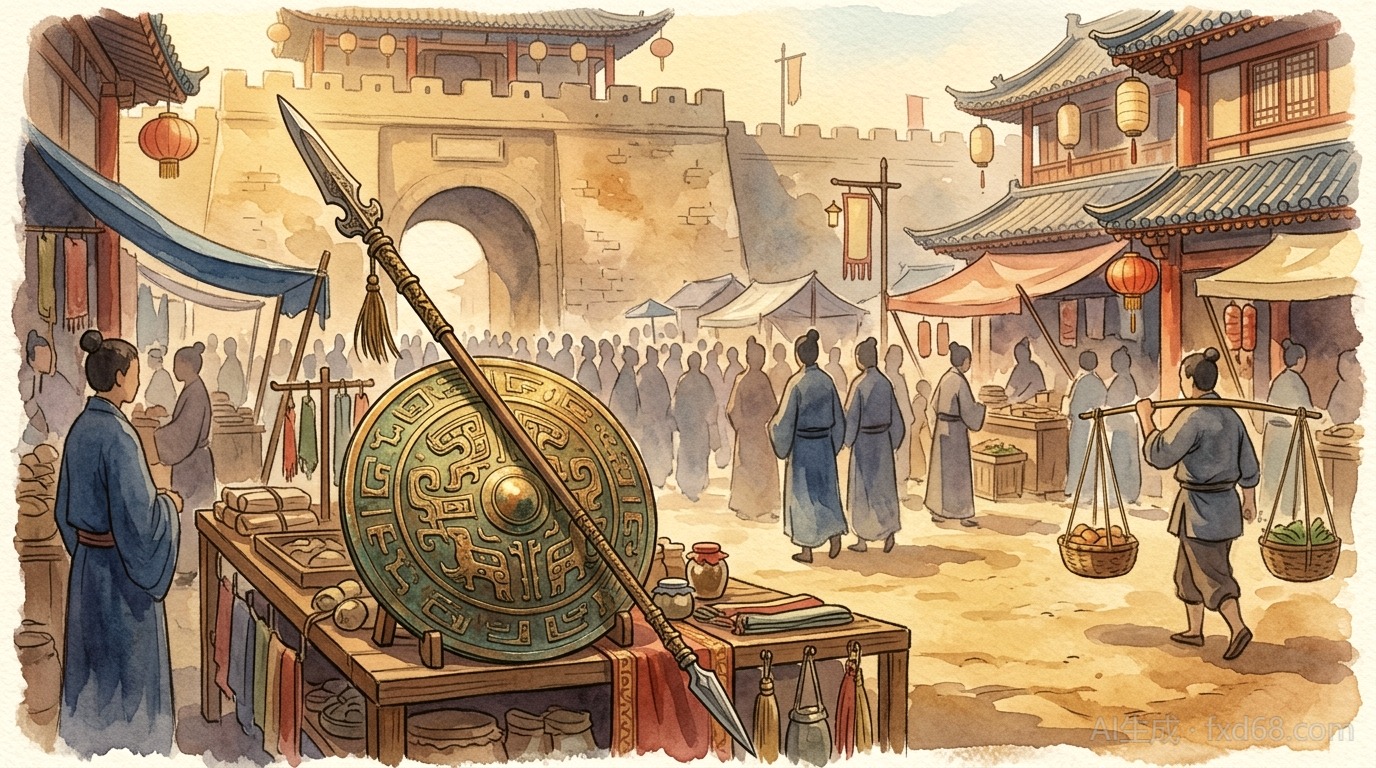
"自相矛盾"出自战国末期思想家韩非(约公元前280年—前233年)写的《韩非子·难一》,原文不到七十个字。有意思的是,韩非讲这个小故事,本来是在一场辩论里打比方:有人既称赞尧把天下治理得完美无缺,又称赞舜去纠正了天下的过错,韩非认为这两种夸奖不能同时成立,于是写道:"尧、舜之不可两誉,矛盾之说也。"
"The Spear and the Shield" comes from the chapter Nan Yi of the Han Feizi, written by the philosopher Han Fei (about 280 to 233 BC) at the end of the Warring States period. The original is fewer than seventy characters long. Interestingly, Han Fei first told it as a comparison in a debate. Some people praised the ancient ruler Yao for governing perfectly, while also praising Shun for correcting the world's faults. Han Fei argued that both kinds of praise could not be true at once, writing that praising both Yao and Shun is just like the tale of the spear and the shield.
矛,是一种长柄的刺杀兵器;盾,是用来挡住攻击的护具。这个故事让"矛盾"两个字合成了一个新词,今天我们用它来表示"前后对不上、互相冲突"。这个词还漂洋过海:日语里写作"矛盾"(读作 mujun),韩语里叫"모순"(mosun),用的也是这两个汉字的读音。
A mao is a long-handled spear for thrusting, and a dun is a shield for blocking attacks. This story joined the two characters into a new word, maodun, which today means a contradiction, things that do not fit together. The word also travelled abroad: Japanese writes it with the same two characters, read mujun, and Korean says mosun, from the same characters too.
🛡️ 第一百七十二个故事,一个夸口的小贩,一根矛和一面盾,还有一个让他答不上来的问题
付费解锁完整故事 · 完整情景对话 · 趣味词卡
- 🛡️ 自相矛盾本期 · NOW
- 🐉 瓦维尔龙点击进入
- 👑 皇帝的新装点击进入
- 🎋 兴夫与孬夫点击进入
- 🐐 三只山羊嘎啦嘎啦点击进入